




Written by a seasoned gold trader for the readers of buygold.blog

Picture this: You’ve located a serious gold supplier in Ghana, negotiated a solid price for 50 kilograms of gold dore, and you’re ready to wire $2.5 million. The seller sends an invoice and a polite promise of “shipment within 72 hours of payment.” You send the money. Days turn into weeks. The tracking number never works. Then the seller’s phone goes dead.
I wish I could say this is a rare story. But having brokered gold deals across Africa, the Middle East, and Europe for over 15 years, I can tell you it’s a recurring nightmare – and it’s entirely preventable. The solution is a simple, centuries-old tool that has finally become the gold standard for international gold transactions: escrow.
As an Expert in Escrow services in Gold Purchases, both international and local, I’m going to walk you through exactly how escrow works in gold trading, why it’s non-negotiable for serious investors, and the critical red flags that separate a safe deal from a sophisticated scam. No generic fluff – just real-world knowledge from the refining floor and the negotiation table.
Table of Contents
- What Exactly Is Escrow?
- How Escrow Works in a Real Gold Transaction
- Why Buyers and Sellers Love Escrow (When Done Right)
- Common Escrow Procedures for International Gold Deals
- Dangerous Red Flags and Escrow Scams to Avoid
- How to Pick a Trustworthy Escrow Provider
- Escrow vs. Direct Payment: A Side-by-Side Look
- Frequently Asked Questions
- Secure Your Gold Deal Today
What Exactly Is Escrow?
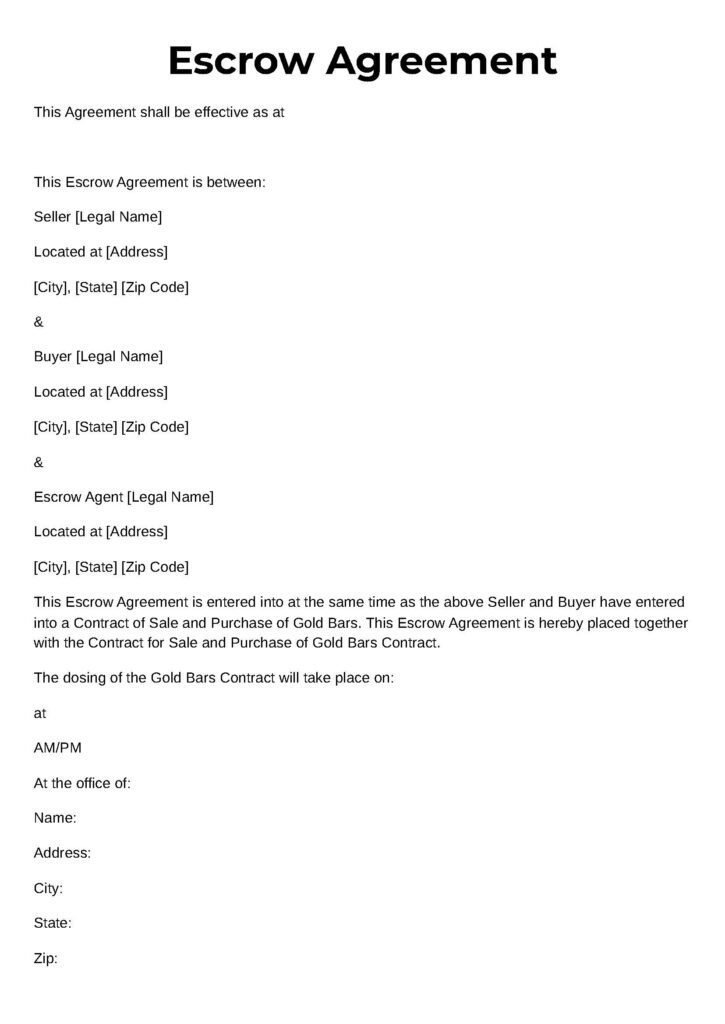
An escrow is a legal arrangement where a neutral third party temporarily holds funds or assets on behalf of a buyer and a seller. In the context of gold escrow services, the buyer deposits the full or partial payment into a secure escrow account. The seller only receives that money after they’ve shipped the gold and the buyer has independently verified its weight, purity, and authenticity.
Think of it as a referee holding the cash until both teams have played by the rules – except here, the field is an assay laboratory and the stakes are often seven figures. Escrow is already standard in real estate and mergers & acquisitions; it is now the defining mark of a professional, secure gold payment arrangement in the commodities world.
The escrow agent isn’t just a passive vault. A properly licensed provider verifies identities, checks compliance with anti-money laundering laws, and ensures that the conditions of your contract are met before moving a single dollar. This neutral oversight is what makes buying gold safely possible when you’re dealing 5,000 miles from home.
How Escrow Works in a Real Gold Transaction
Let me walk you through a real scenario I facilitated just last year: a $500,000 purchase of 10 kg of gold bars from a refinery in Uganda, destined for a buyer in Dubai. This step-by-step timeline is exactly what using an escrow for gold buyers looks like.
Step 1: Agree on Terms and Contract
Both parties sign a comprehensive Sales and Purchase Agreement (SPA). This document specifies the gold’s exact specifications – fineness (e.g., 99.99%), bar weight tolerance, brand, shipping method (armored courier or air freight), insurance, and the exact inspection protocol. Crucially, it also names the mutually agreed escrow provider and the conditions for releasing funds.
Step 2: Buyer Opens Escrow
The buyer contacts the licensed escrow provider and deposits the full $500,000. The escrow company confirms receipt in writing to both buyer and seller. Nobody can touch these funds now except under the terms of the agreement.
Step 3: Seller Ships the Gold
Confident that the money is secured, the seller arranges logistics, exports the gold legally, and provides all documentation: airway bill, certificate of origin, assay report, and export permit. The shipment is fully insured, and the tracking number is shared with all parties.
Step 4: Independent Inspection
Upon arrival in Dubai, the gold is taken directly to an independent LBMA-accredited refinery or assay office. An independent umpire assayer – agreed upon in the contract – performs a melt assay and XRF analysis. The buyer or their representative physically witnesses the process. Only when the outturn report matches the contracted purity and weight down to the acceptable tolerance (usually 0.1%) does the buyer give their approval.
Step 5: Release of Funds
The buyer sends a signed release instruction to the escrow agent. Within 24 to 48 hours, the $500,000 is wired to the seller. The deal closes. If the gold fails the assay, the buyer rejects the shipment, the seller is notified, and the gold is returned (at the seller’s cost). Only once the rejected gold is securely back with the seller or destroyed under agreed terms do the funds return to the buyer.
In some bulk deals, I structure milestones: 30% placed in escrow before shipment, 70% after a positive assay. This is what a gold trade escrow looks like when it’s built to protect every link in the chain.
Why Buyers and Sellers Love Escrow (When Done Right)
For Buyers
- Zero payment risk: You release funds only after physically verifying the gold. No more paying for air or brass bars.
- Bait-and-switch killer: The inspection step neutralizes the common trick of showing real gold at the mine gate and shipping dore bars of drastically lower purity.
- Legal leverage: The escrow agreement gives you a clear, enforceable path to a refund if the seller defaults.
For Sellers
- Guaranteed commitment: Escrow proves the buyer has the money and isn’t a time-waster. For serious international gold transactions, this is a badge of a genuine counterparty.
- Payment protection: The seller knows they won’t ship $500,000 of gold only for the buyer to fabricate a quality dispute or vanish. Once the assay confirms the goods, funds are released automatically.
- Market credibility: Offering to use a recognized gold escrow provider signals you are a professional, not a backyard broker. I’ve had African refinery owners tell me that since they started using escrow, their pool of serious international buyers has tripled.
Common Escrow Procedures for International Gold Deals
International gold escrows follow protocols shaped by the London Bullion Market Association (LBMA) and the International Chamber of Commerce (ICC). When I structure a cross-border transaction, here are the procedures that almost always apply:
- KYC & AML Compliance: The escrow provider will require certified passports, corporate documents, proof of funds, and a documented chain of custody for the gold. This is mandatory under global anti-money laundering rules.
- The Refinery Hub Model: For refined gold, many deals specify delivery to an independent refinery in Switzerland, Dubai, or India. The escrow is released strictly against the refinery’s official outturn weight and assay. No external certificates are accepted.
- OECD Due Diligence on Source: For gold originating from the Great Lakes region in Africa, the escrow agreement often mandates a clause aligned with the OECD Due Diligence Guidance for Responsible Supply Chains. Funds are only released after proof that the gold is conflict-free. (See OECD Guidance)
- Partial Shipments and Tranche Releases: For large consignments (100 kg+), gold is shipped in tranches. A corresponding percentage of escrowed funds is released after each tranche passes the assay, keeping the cash flow manageable.
- Letter of Credit Overlay: Some transactions combine a confirmed Irrevocable Letter of Credit (LC) with an escrow account. The LC guarantees payment upon document presentation, while the escrow holds cash as a performance bond. This is common in West African gold exports.
These procedures transform a high-risk gamble into a structured, bankable gold trade escrow that institutional buyers are comfortable with.
Dangerous Red Flags and Escrow Scams to Avoid
Here’s the uncomfortable truth: scammers have weaponized the very word “escrow.” They understand that sophisticated buyers demand it, so they create elaborate fakes. After three decades in the trade, these are the warning signs I never ignore.
- The “Preferred Escrow” Trap: A seller insists you use their nominated escrow provider, claiming “they’ve worked with them for years.” Nine times out of ten, that website is a front. Always choose the escrow provider independently or have equal say in the selection.
- No Independent Assay Clause: If the escrow agreement releases funds solely upon proof of shipment (tracking number) or a seller-provided assay certificate, you are completely unprotected. Real escrow for gold always hinges on an independent umpire assay.
- Unregulated Jurisdictions: Be extremely cautious of escrow agents registered in offshore secrecy havens with no financial regulator. Legitimate companies are licensed by bodies like the UK’s Financial Conduct Authority (FCA), a US state banking department, or the Dubai Financial Services Authority (DFSA). If you cannot verify their license on a government website, walk away.
- High-Pressure “Deal Expiring” Tactics: “My seller is offering a 2% discount if we close escrow today.” Real gold transactions on this scale are never lightning-fast. Urgency is a weapon of the fraudster.
- Clone Websites: Criminals replicate real escrow sites with a slightly altered domain name (e.g., escrow-secure.com instead of escrow.com). Always type the escrow provider’s URL directly into your browser – never click a link in an unsolicited email.
- Crypto-Only Escrow: While legitimate crypto escrow exists for digital assets, any seller pushing a Bitcoin-only escrow for physical gold who refuses a fiat alternative is likely exploiting cryptocurrency’s irreversibility. Stick to regulated, fiat-based escrow for buying gold safely.
I once caught a fake escrow site that even had a live chat feature manned by the scammer, who sent me a forged bank receipt. One five-minute phone call to the real escrow company’s publicly listed number exposed the entire ruse. Trust, but verify – literally by telephone.
How to Pick a Trustworthy Escrow Provider
When my clients ask me for a gold escrow provider recommendation, I hand them this checklist and tell them to tick every box:
- Licensing & Regulation: Verify the company’s license with the specific state, province, or national regulator. In the US, you can check through the state’s Department of Financial Institutions. In the UK, the FCA register. The company’s registration number should be prominent and match public records.
- Commodity Experience: Ask directly, “Have you handled gold transactions before? Do you understand the difference between an XRF surface reading and a fire assay?” A generic escrow service designed for domain name sales doesn’t understand gold tolerances.
- Segregated Client Accounts: Your funds must be held in a dedicated, insured trust account at a top-tier bank – never in the escrow company’s general operating account.
- Transparent Fee Structure: Industry rates range from 0.5% to 2% of the transaction value, often split between parties. A fee that is suspiciously low or “free” is the hallmark of a fake. (For reference, services like Escrow.com are transparent about their tiered pricing.)
- Defined Dispute Resolution: The escrow agreement must spell out the arbitration process (e.g., under ICC rules) and what happens in the case of a failed assay. No ambiguity.
- Fidelity Insurance: Does the escrow agent carry insurance against employee theft or errors? This protects you if the escrow firm itself becomes insolvent or fraudulent.
While I do not endorse any single company, many serious gold traders have successfully used licensed providers such as Escrow.com (US-licensed) or Transpact.com (UK FCA-authorized) for commodity deals. Some international gold transactions use the client trust account of a reputable law firm as an escrow vehicle, but this is only safe if funds are held in a separately designated escrow account with full bank-level protections.
Escrow vs. Direct Payment: A Side-by-Side Look
A direct bank wire (T/T) is fast. It’s also the gold scammer’s best friend. Here is how escrow compares directly with wiring money straight to a seller’s account in a high-value international gold transaction.
| Aspect | Escrow | Direct Payment |
|---|---|---|
| Security | Funds are released only after the gold is inspected and verified. | No recourse; once money leaves, you are an unsecured creditor. |
| Cost | Typically 0.5% – 3% of transaction value. | Usually only the SWIFT wire fee ( $30-$100 ). |
| Payment Speed to Seller | 3–10 business days after shipment arrival and assay. | Instant or within 1-2 days upon wire. |
| Dispute Resolution | Built-in mediation and arbitration via the escrow agreement. | Cross-border litigation in foreign courts, often futile. |
| Trust Required | Minimal – you trust the escrow process and the umpire assayer. | Maximum – you must fully trust an unseen, unvetted seller. |
| Buyer Control | Complete; you can reject non-conforming goods before funds move. | Zero control after the “send” button is clicked. |
| Industry Acceptance | Becoming the mandatory standard for large gold deals. | Viewed as highly unprofessional above a certain value. |
For any gold purchase over $50,000 with a new counterparty, I would consider skipping escrow to be an act of financial negligence. The modest fee is the cheapest insurance policy you will ever buy.
Frequently Asked Questions
Q: Is escrow really safe for buying gold from Africa?
A: Absolutely – when structured correctly. The safety comes from the combination of a neutral, licensed escrow agent and an independent assay laboratory. I have closed dozens of gold escrow services transactions originating in Ghana, Mali, and Tanzania without a single loss. The key is that funds are never released until the gold is in a secure, third-party lab and verified.
Q: How long does a typical gold escrow transaction take?
A: Once the seller ships, factor in 5 to 15 business days for logistics, customs clearance, and the actual umpire assay at the destination. Fund release after buyer approval is usually within 1-2 business days.
Q: Can I use escrow for a small, $5,000 gold purchase?
A: You can, but fixed escrow fees can eat into smaller margins. Escrow delivers its strongest value on **international gold transactions** above $20,000. For smaller amounts, you might consider a reputable online bullion dealer with built-in buyer protection, though that won’t apply to direct mine purchases.
Q: What happens exactly if the gold fails the assay?
A: The contract will dictate this. Typically, the buyer issues a rejection notice. The escrow funds remain frozen. The seller must either replace the conforming gold or arrange and pay for the return shipment of the rejected material. Only when the gold is back in the seller’s possession (or destroyed under mutual witness) are the buyer’s funds returned. Never agree to a contract that forces you to accept substandard gold.
Q: How do I verify an escrow company is not a scam?
A: Look up their registration number on the regulator’s official website (not a link they sent you), call their head office to speak with an officer, and verify their physical street address using Google Maps. Cross-reference reviews on independent platforms. A real provider will never object to this scrutiny.
Secure Your Gold Deal Today
In more than fifteen years brokering precious metal deals across three continents, I have never heard a trader say they regretted using a properly constituted escrow. I have, however, consoled many who lost their capital because they trusted an invoice and a handshake.
Escrow replaces blind trust with verifiable truth. It is the difference between a professional portfolio transaction and a cautionary tale whispered at trading conferences.
At buygold.blog, we are committed to arming you with the knowledge to navigate the gold market safely. Before you wire a single dollar for that next shipment from Accra, Bamako, or Kampala, ask yourself one question: “Is my money truly protected?” If the answer isn’t a confident yes, set up an escrow.
Trade smart. Stay safe. In the gold business, integrity and structure are your greatest assets.
— The buygold.blog editorial team, written by an active international gold broker.