

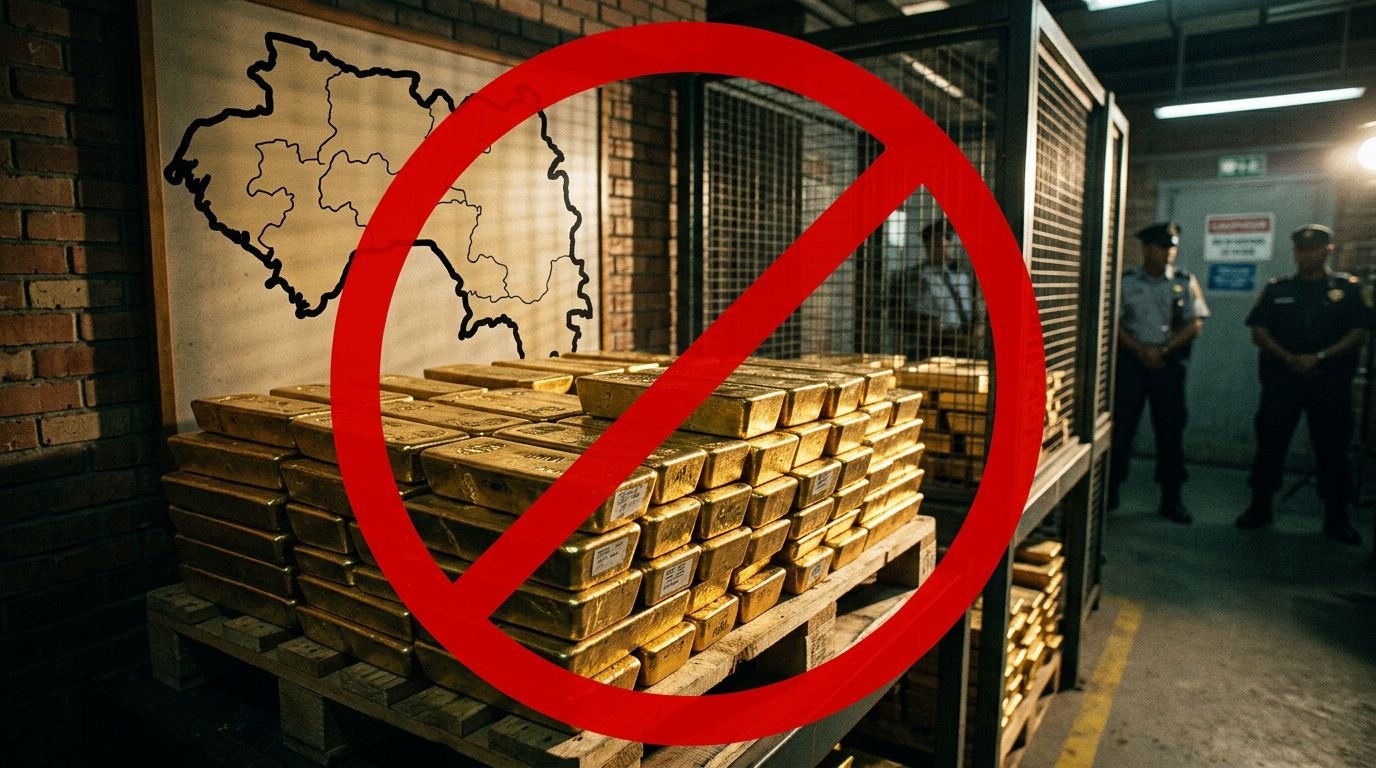
CONAKRY — In a sweeping move that has sent shockwaves through global commodity markets, Guinea has enacted an immediate Guinea gold export ban on all unrefined precious metals.
The strategic shift directly mirrors a broader wave of resource nationalism tightening across the continent, arriving on the heels of Zimbabwe’s recent enforcement of a strict raw lithium export freeze.
President General Mamady Doumbouya declared the policy shift following intense, high-level consultations in the capital with industrial mining executives, artisanal gold producers, and regional trade brokers.
“Guinea possesses the second-largest gold reserves in West Africa, but its gold leaves the country daily in its raw state to be processed, certified, and sold elsewhere,” President Doumbouya announced in a nationwide broadcast via the state-owned Radio Télévision Guinéenne (RTG). “I am putting an end to that starting today. Guinea will now require its gold to be processed within its own borders. Raw gold will no longer leave Guinea.”
Strict Penalties for International Mining Companies
The military-led government has established rigid parameters to ensure total compliance. Moving forward, the Ministry of Mines and Geology dictates that precious metals can only cross international borders once they have been melted down, purified, and shaped into standard ingots at the newly established Nimba Gold Refinery in the Gbessia district of Conakry.
For foreign mining syndicates, the ultimatum is non-negotiable. Violators attempting to bypass the domestic processing mandate face catastrophic regulatory penalties:
Immediate suspension of corporate operating licenses.
Outright termination of active bilateral mining agreements.
Seizure of unprocessed minerals at ports of exit.
High Economic Stakes: Assessing Guinea’s Gold Sector
While Guinea is globally recognized as the leading exporter of bauxite, its gold reserves form a vital component of domestic sovereign revenues. According to formal data released by the Ministry of Mines and Geology, the nation exported an impressive 22,142 kilograms of gold in the first quarter of the year alone.
The industry operates through a complex mix of major industrial players including AngloGold Ashanti’s powerful subsidiary, Société Aurifère de Guinée alongside two semi-industrial corporations and thousands of informal artisanal mining syndicates.
Guinea Gold Production Snapshot
Metric / Sector Indicator Volume / Detail Q1 Export Volume 22,142 Kilograms Regional Reserve Rank Second-largest in West Africa Primary Industrial Operator Société Aurifère de Guinée (AngloGold Ashanti) Centralized Refining Hub Nimba Gold Refinery (Gbessia, Conakry) Until the Nimba facility is fully scaled to accommodate both the massive artisanal and industrial volumes, mining firms may be forced to temporarily stockpile their unrefined products within domestic storage hubs.
The Rise of Africa’s Resource Nationalism Trend
Guinea’s aggressive economic maneuvering is part of an escalating geopolitical trend across sub-Saharan Africa. Governments are systematically rewriting historical colonial frameworks to capture downstream supply chain value, boost local employment, and insulate emerging markets from volatile global commodity fluctuations.
Similar supply chain blockades are playing out across neighboring jurisdictions:
Zimbabwe: Enforced an absolute ban on raw lithium concentrates to build domestic battery-grade manufacturing industries.
Mali & Burkina Faso: Progressing rapidly on state-backed gold refinery constructions to bypass European certification monopolies.
Niger: Advancing localized precious metal processing plants under the Alliance of Sahel States (AES) economic framework.
By shifting from cheap raw mineral exports to high-margin, certified domestic processing, Africa’s mineral powerhouses are drawing a definitive line in the sand demanding that foreign capital build infrastructure inside the borders where the wealth is drawn.
